Primordia Co.Grounded World Models

Appendix D The Sampling Budget: Latency vs Residual Monte-Carlo Error

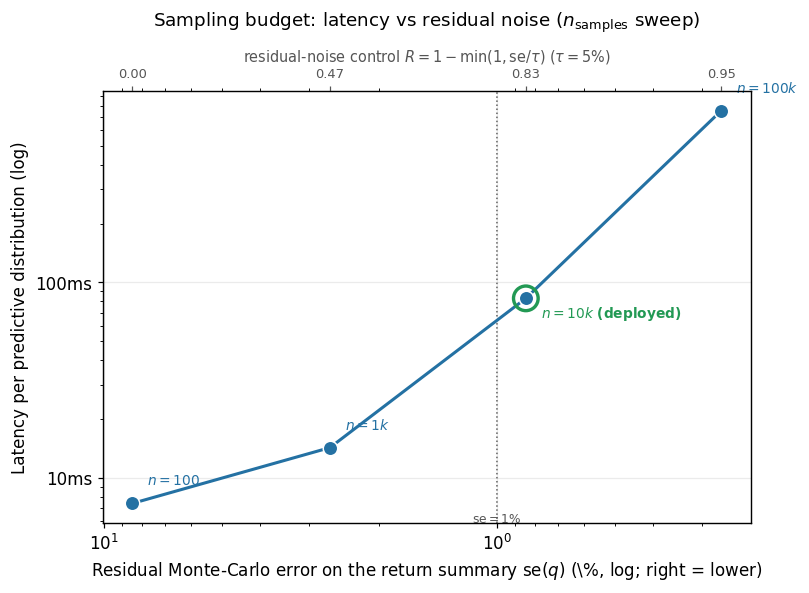
Every GWM headline (target price, direction probabilities, scenario mix) is a functional of nsamples Monte-Carlo draws, so the sample budget trades latency against the residual noise that enters the residual-noise control R(q)=1min(1,se(q)/τ) of Definition 11. We fix nsamples=10,000 throughout; this appendix justifies that choice. Sweeping by powers of ten over the cost-benchmark cases of Appendix F (warm median wall-clock; standard error of T(q)=𝔼[upside] estimated as se(q)=σ^upside/nsamples), Figure 7 plots the tradeoff.

Refer to caption
Figure 7: Choosing the sampling budget: latency vs residual noise. Latency per predictive distribution (log, vertical) against the residual Monte-Carlo standard error on the return summary (log, horizontal; right = lower error = better), swept over powers of ten and aggregated as the median over recent deployed v1 cases. The residual falls as the textbook n1/2 (each decade cuts it 3.2×), while latency is flat below a per-call overhead floor and then rises roughly linearly—so the curve’s geometric elbow is near n=1k, not at the deployed budget. We nonetheless deploy n=10k (circled) for sufficiency, not because it is the elbow: it is the smallest budget whose residual clears the decision-relevant se1% band (dotted; R0.83 at τ=5%) while latency is still sub-100ms. The elbow at 1k is too noisy (se2.7%, R0.47—enough to flip a direction call), and the next decade to 100k pays 9× the latency for a further 10 residual reduction that no longer moves a decision. The top axis reads the same residual as the bounded residual-noise control R=1min(1,se/τ) (Def. 11).

Two regimes bracket the choice: below 103 samples a fixed per-call overhead floors the latency while the residual balloons, and above 104 the sampling loop dominates, so each further decade costs a near-full decade of latency for only a 10 residual gain. The 10,000-sample budget clears the floor and drives R into saturation at sub-second latency; because the residual scales as n1/2, only the absolute latency floor (hardware) moves with the case mix, not the choice itself.