4 Discussion
4.1 Three usage modes of GWMs
As discussed in Section 1, LLM-powered workflows are increasingly applied to real-world decision tasks. The natural taxonomy is by the driver of the decision loop—who chooses the next action given the GWM’s posterior—which takes three values: a human, an LLM agent, or an algorithm. The first is human-in-the-loop; the latter two are autonomous, distinguished by whether the driver reasons in language or in code (Figure 5).
Mode 1: human-driven (decision-support).
When a GWM informs a human analyst, the GWM’s key value proposition is the trustworthiness justified by XQ (See Prop. 1): a LLM memo can be persuasive while being wrong in ways the analyst cannot audit. An LLM retains its role as a natural-language interface to the GWM’s structured inputs and outputs.
Mode 2: LLM-driven (neurosymbolic agent).
We foresee deployments pairing the GWM with an autonomous LLM agent, where the GWM is the verified predictive core that lends the agent stiffness and reliability: the LLM explores, frames, and explains, while the GWM computes the posterior, thus implementing the neurosymbolic pattern proposed in Garcez (2025). The instructive contrast is with GraphRAG (Edge et al., 2024), which augments the LLM with a static knowledge graph: it raises assumption consistency but returns text, not a posterior under an explicit mechanism, so it gains neither grounding nor proper Bayesian updating. The analogy that does work is the coding harness—just as agents increasingly call deterministic, verified code rather than re-deriving it, a decision agent should call a verified GWM rather than re-asserting probabilities. In the RAIL design space of Chiatti et al. (2026), this places the GWM at the demanding corner of every axis at once—verified-by-design assurances, structured-symbolic interfacing, and knowledge-guided learning—with the LLM supplying the neural, exploratory half; it is precisely this combination, rather than any single axis, that the narrative baselines forgo.
Mode 3: algorithm-driven (MPC / active inference).
When a GWM drives a control loop with no language model in the decision path—rebalancing a position, dispatching capital—predictions must be produced on a fixed cadence and support counterfactual rollouts for planning. This is model-predictive control (MPC), and in the probabilistic setting, active inference (Friston et al., 2017): the agent selects actions minimizing a expected free energy functional under .
4.2 An illustrative look at cost and capability
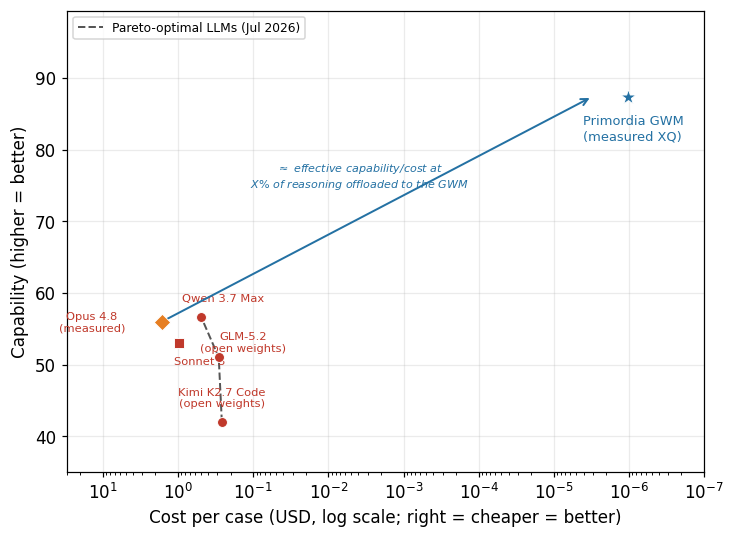
Figure 6 situates the GWM against the general-purpose LLM cost/capability frontier of July 2026. The point is deliberately illustrative—the GWM does not carry an Intelligence Index score, since it is not a general-purpose model—but the qualitative claim is precise: the GWM is not another point competing on this frontier, it is a domain-specific capability that a Mode-2 agent calls on relevant tasks, the same way it calls a verified code tool, thus obtaining strict improvements along both cost and capability axes.191919The domain-specific finance benchmark (Vals AI, 2026) reproduces not just this ranking but the frontier’s shape: accuracy barely moves across a wide cost and latency range, and the priciest, slowest models are not the most accurate—notably diminishing returns to even major model advances and test-time compute. This is exactly the behavior Proposition 5 and the super-linear NWM cost curve (Eq. (8)) predict: added inference budget cannot clear the ceiling.
4.3 Why a GWM is capital
A GWM is reusable capital: built and verified once for a task class, then applied to many instances at near-zero marginal cost (the amortization of Section 3.2). This is what makes “call a verified model” the rational default over “re-derive each time”—what we call the returns to crystallization. The intuition is that a valid solution to a high-stakes task must satisfy a product of constraints at once, so the cost of finding one afresh grows exponentially in task complexity, whereas reusing a verified model costs only an grounding step. The resulting leverage is large and—decisively—is dominated by failure avoidance: the value destroyed when an unverified search silently fails and propagates downstream, a term that does not shrink as token prices fall (we make this quantitative in Appendix B). Hence a rational principal does not re-derive a grounded model per instance; it calls a verified one, exactly as agentic coding increasingly calls verified library code rather than re-synthesizing it—and because a GWM’s reuse cost is the grounding inference itself, climbing the groundedness ladder and earning this leverage are the same act.
4.4 Generalization and scope
Little in this paper is specific to finance. Any domain requiring structural causal prediction—supply-chain risk, epidemiology, grid planning, macroeconomic policy—has the same groundedness axis and the same contrast between a verified posterior and a narrated one. The GWM structure transfers directly; only the latents and the evidence change. That said, any given GWM only produces predictions within its domain, by construction; the definition of a domain is arbitrary and can extend well beyond typical discipline walls202020For instance, successful investment analysis often requires some predictive capability on the industries in question, as well as systemic factors such as macroeconomics, geopolitics, nature and climate., but we do not foresee the construction of a single GWM capable of answering arbitrary queries on any domain in the same sense as LLMs can; at least in the short term, combining domain-specific GWMs with an orchestrator LLM as in Modes 1 and 2 of Section 4.1 appears to be a highly valuable pragmatic compromise.
For simplicity, this paper treats predictions for different cases as siloed, independent contexts. However, a decision-maker typically must make decisions that are coupled across cases—for instance, stocks in a portfolio are typically causally correlated. A GWM can naturally be structured to represent such real-world couplings, producing joint posteriors over an effectively unlimited universe. Doing so reveals an even more striking advantage against NWMs, which must maintain coherence across cases using LLM attention mechanisms, at superlinear cost and without any structural guarantees. We will expand on this significantly in a follow-up paper (Kaufmann et al., 2026).